Capsules remain one of the most widely used pharmaceutical dosage forms in the world.
From prescription medicines and nutraceuticals to dietary supplements and over-the-counter (OTC) products, capsules continue to be a preferred delivery format because they are easy to consume, versatile and relatively straightforward to manufacture at scale.
As global demand for pharmaceutical and nutraceutical products continues to grow, many manufacturers are considering investing in a capsule manufacturing plant to expand production capacity, enter new markets or establish local manufacturing capabilities.
However, setting up a capsule manufacturing unit is far more complex than purchasing a capsule filling machine and constructing a building around it.
A modern capsule manufacturing facility must support regulatory compliance, contamination control, efficient production flow, quality assurance, utility integration, scalability and long-term operational efficiency. Every design decision made during the planning phase influences the facility’s future performance.
In our experience, one of the most common mistakes manufacturers make is treating facility construction, cleanroom design, utilities, equipment selection, and compliance as separate projects.
They are not.
A capsule manufacturing plant functions as a highly integrated ecosystem where every system influences the others. Facility design affects workflow. Workflow affects productivity. Utilities affect process stability. Cleanroom performance affects product quality. Documentation affects regulatory approvals.
When these elements are planned independently, projects often encounter delays, redesigns, validation challenges, and budget overruns.
This is why we believe successful pharmaceutical facilities begin with integration from day one.
Why capsule manufacturing requires careful facility planning.
Capsule production may appear straightforward from the outside.
Raw materials arrive. Ingredients are blended. Capsules are filled. Finished products are packaged and distributed.
In reality, however, every stage of capsule production must operate within tightly controlled conditions.
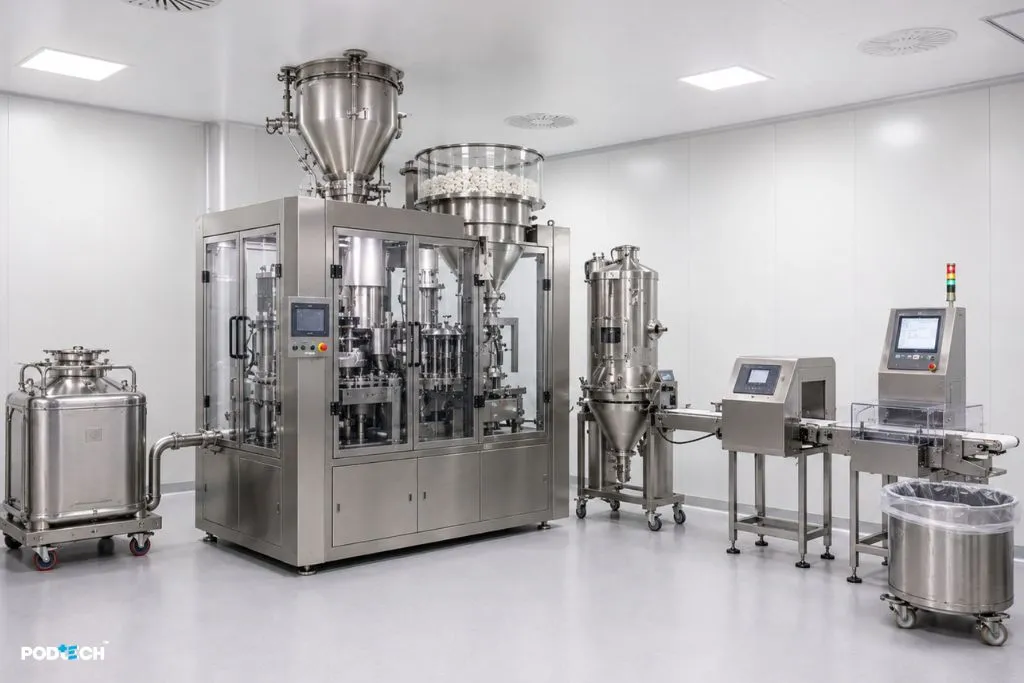
Depending on the products being manufactured, facilities may need to support raw material storage and dispensing, weighing and batching operations, blending and granulation and capsule filling. Beyond this, capsule manufacturing units must also incorporate into their processes capsule inspection, packaging operations, quality control laboratories, environmental monitoring and controlled storage areas.
Each process has unique environmental and operational requirements.
Materials must move efficiently through the facility without creating contamination risks. Personnel movement must be carefully managed. HVAC systems must maintain appropriate temperature, humidity, and pressure differentials. Utilities must operate reliably without disrupting production.
The challenge becomes even greater when manufacturers plan for future growth (as they should).
Many capsule manufacturers begin with a single product line but later expand into multiple formulations, export markets, or higher production volumes. Without proper planning, future expansion often becomes expensive and disruptive. This is why facility planning should always consider not only current production requirements but also long-term business objectives.
Understanding the true cost of a capsule manufacturing plant.
One of the first questions manufacturers ask is simple:
“What is the capsule manufacturing plant cost?”
The answer depends on far more than the size of the building.
Many organisations focus on equipment costs alone while underestimating the infrastructure required to support compliant pharmaceutical production. The total investment typically includes the costs of land and site development, building construction, cleanrooms and controlled environments, HVAC systems, process utilities, electrical infrastructure, water systems, process equipment, automation systems, validation and qualification, regulatory documentation and personnel training.
A facility designed solely around minimising upfront capital expenditure can often become significantly more expensive over its operational lifetime. How, you ask? Poor layouts create inefficiencies. Inadequate utility planning leads to future upgrades. Limited expansion capability results in costly reconstruction projects.
This is why experienced facility developers evaluate capsule manufacturing plant cost from a lifecycle perspective rather than simply a construction perspective.
The objective is not merely to build a facility. The objective is to build a facility that performs efficiently for years to come.
Why capsule manufacturing plant layout matters.
One of the most important decisions during facility planning is the capsule manufacturing plant layout.
A well-designed layout supports:
- Efficient material flow
- Logical process sequencing
- Reduced contamination risks
- Improved productivity
- Easier maintenance
- Regulatory compliance
- Future expansion
The best facility layouts are developed around manufacturing processes rather than architectural convenience.
For example, raw materials should move logically from receiving through dispensing, processing, filling, inspection, packaging and finished goods storage. Similarly, personnel movement should minimise unnecessary traffic between clean and non-clean areas. Quality control laboratories, warehouses, utilities, and support areas must also be positioned strategically to support efficient operations.
A facility’s layout can influence productivity for decades after construction is complete. At PodTech™, we often find that investing more time in layout planning at the beginning of a project significantly reduces operational challenges later.
The challenge of fragmented project execution.
One of the most common reasons facility projects exceed budgets or timelines is fragmented project management.
Different consultants may be responsible for facility design. Separate vendors may provide HVAC systems. Another supplier may handle cleanrooms. Equipment vendors focus only on machinery. Validation consultants become involved later.
Each party performs its own role effectively, but nobody is responsible for ensuring the entire system functions together.
The consequences often include design conflicts, delayed installations, utility mismatches, validation challenges, documentation gaps and costly rework.
We’ve seen similar challenges across pharmaceutical manufacturing projects of all types. In fact, many of these risks are explored in our article on Building a clinical biomanufacturing facility: Why turnkey is becoming the industry standard, where we discuss why integration planning is essential from the earliest project stages.
The value of a turnkey approach.
This is precisely why many manufacturers now prefer turnkey project delivery.
A turnkey partner assumes responsibility for the entire project lifecycle. From planning and design to engineering, procurement, construction, commissioning, validation and handover, a single team coordinates every aspect of the project.
Rather than receiving a partially completed facility requiring further integration, manufacturers receive a ready-to-operate capsule manufacturing unit.
At PodTech™, we view turnkey delivery as much more than project management. It is a philosophy that places integration at the centre of every decision.
Whether we are designing cleanrooms, engineering utilities, integrating HVAC systems or deploying modular infrastructure, our objective remains the same: delivering a complete operational environment rather than a collection of independent systems.
In part 2 of this guide, we’ll explore what manufacturers should expect from a turnkey capsule manufacturing project, the major stages involved in facility development and how the right delivery partner can help reduce risk while accelerating time to market.
In part 1, we explored why capsule manufacturing facilities require careful planning and why integration plays such a critical role in project success.
Now, let’s look at what manufacturers can expect when setting up a capsule manufacturing plant, the key stages involved in facility development, and how a turnkey approach can help reduce project risk while accelerating operational readiness.
What should you expect from a modern capsule manufacturing facility?
A successful capsule manufacturing facility is more than a compliant building housing production equipment. It is an environment specifically designed to ensure product quality, operational efficiency, regulatory compliance and future scalability.
When evaluating a new facility project, manufacturers should look to tick the following items off their checklist:
- Efficient production workflows
- Reliable environmental controls
- GMP-compliant operations
- Scalable infrastructure
- Integrated utilities
- Robust quality systems
- Simplified maintenance
- Future expansion capability
Achieving all of these objectives simultaneously requires far more than good construction. It requires strategic planning, integrated engineering, and coordinated execution. This is where turnkey project delivery creates significant value.
Why turnkey delivery simplifies capsule manufacturing projects.
Setting up a capsule manufacturing plant often involves numerous stakeholders.
Architects. Civil contractors. HVAC consultants. Cleanroom suppliers. Utility specialists. Equipment vendors. Validation teams. Documentation experts… the list is endless.
Managing all these parties independently can quickly become overwhelming. Every design revision affects multiple systems. Delays in one area can create knock-on effects across the entire project.
A turnkey partner eliminates much of this complexity by providing single-point responsibility.
Rather than coordinating multiple suppliers yourself, you work with one team responsible for overall project success. This reduces communication gaps, accelerates decision-making and improves accountability throughout the project lifecycle.
For many manufacturers, this alone justifies the turnkey approach.
Compliance starts with facility design.
Pharmaceutical manufacturing is one of the most highly regulated industries in the world. Regulatory authorities expect manufacturers to demonstrate consistent control over products, processes, facilities, equipment, and documentation.
The challenge is that compliance cannot be added after construction is complete. It must be designed into the facility from the beginning.
A fully compliant capsule manufacturing plant includes the following:
- GMP-compliant layouts
- Appropriate cleanroom classifications
- Personnel and material segregation
- Controlled HVAC systems
- Validated utilities
- Environmental monitoring
- Documentation systems
When compliance considerations are incorporated early in the design process, validation becomes significantly smoother. This is one of the reasons many manufacturers choose turnkey partners. Experienced facility providers understand how operational requirements and regulatory expectations influence every design decision.
Many of these same principles are discussed in our article on The complete guide to cleanroom solutions for pharmaceutical manufacturing, which explores the relationship between facility design and regulatory readiness in greater detail.
Managing capsule manufacturing plant cost effectively.
Every manufacturer wants to control project costs. However, effective cost management is not simply about reducing expenditure. It is about allocating capital intelligently.
The lowest-cost solution is not always the most economical solution over the life of the facility. For instance, poor layouts reduce productivity. Undersized utilities limit future expansion. Inefficient HVAC systems increase operating expenses. Inadequate planning leads to expensive rework.
A well-designed capsule manufacturing plant balances capital investment with long-term operational efficiency. This is why experienced turnkey partners focus on lifecycle value rather than construction cost alone.
Strategic planning helps identify opportunities to reduce waste, optimise utility consumption, simplify maintenance and support future growth. Over the lifespan of the facility, these decisions can generate significant savings.
Building the right capsule manufacturing plant layout.
As we’ve discussed in part 1, the capsule manufacturing plant layout is one of the most influential factors in long-term operational success. An effective layout supports both compliance and efficiency.
Key considerations to ensure an effective layout include:
Material flow. Raw materials should move logically through receiving, dispensing, processing, filling, inspection, packaging and storage without unnecessary movement or cross-contamination risks.
Personnel flow. Employee movement should be carefully managed through gowning areas, airlocks and controlled access points.
Environmental segregation. Different production activities may require different environmental conditions. The layout should support appropriate segregation between processing zones.
Maintenance accessibility. Equipment and utility systems should remain accessible for maintenance without disrupting production operations.
Future expansion. Additional production lines, packaging areas or warehouse space should be accommodated without requiring extensive reconstruction.
The most effective layouts are developed with a long-term operational perspective rather than simply maximising available floor space.
The key stages involved in setting up a capsule manufacturing plant.
So, what does the actual process of setting up a capsule manufacturing plant look like?
While every project is unique, most turnkey capsule manufacturing facilities follow a similar sequence.
- Strategic planning and feasibility analysis
Every successful project begins with understanding business objectives.This stage typically includes the steps of production capacity planning, market analysis, site evaluation, budget development, regulatory considerations and risk assessment. The goal is to establish a realistic foundation before major investments are made.
- Facility design and engineering
Once project requirements are defined, detailed design begins. This includes facility layouts, process workflows, cleanroom design, HVAC engineering, utility planning, electrical systems and automation requirements.At this stage, integration becomes critical because every system must function together as a single operational environment.
- Procurement and construction
Following design approval, procurement and construction activities begin. This phase typically includes the following activities:
- Civil construction
- Cleanroom installation
- Utility infrastructure
- Mechanical systems
- Electrical systems
- Process equipment procurement
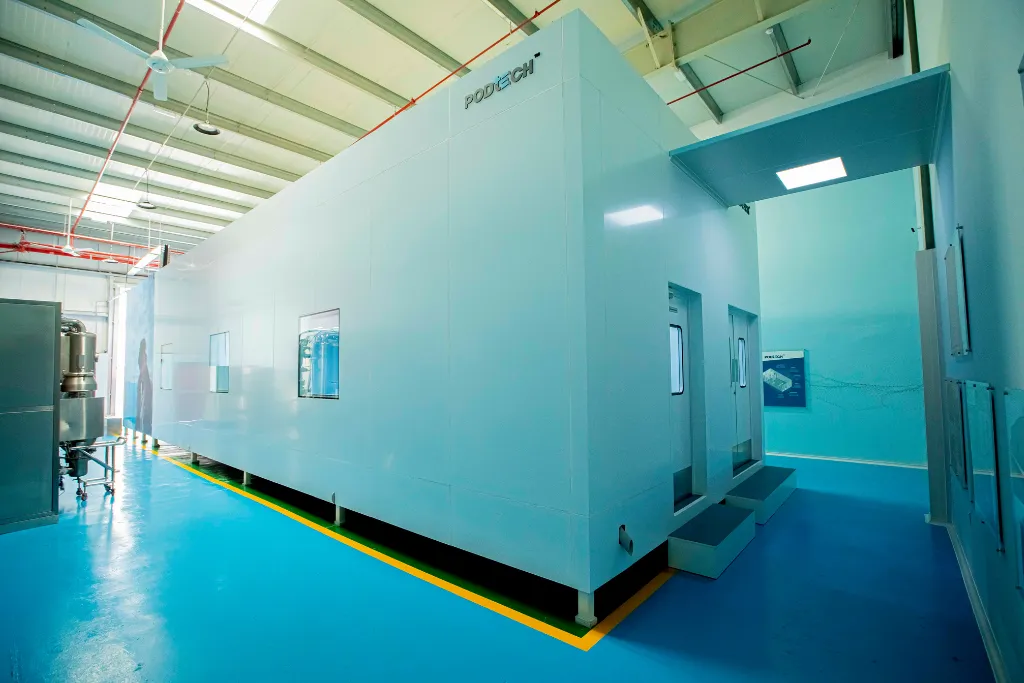
Modern modular and prefabricated solutions can significantly accelerate this stage by reducing on-site construction requirements while maintaining quality and compliance.
- Equipment installation and validation
Once equipment is installed, qualification and validation activities begin. These typically include Installation Qualification (IQ), Operational Qualification (OQ) and Performance Qualification (PQ). These activities help verify that systems have been installed correctly, operate as intended and consistently support product quality.
- Documentation and regulatory preparation
Documentation is a cornerstone of pharmaceutical compliance. A turnkey partner should support:
- SOP development
- Validation documentation
- Risk assessments
- Equipment documentation
- Quality manuals
- Training records
Comprehensive documentation simplifies audits and supports regulatory approvals.
- Personnel training
Even the best facility cannot perform effectively without trained personnel. Operators, maintenance teams, quality professionals and supervisors must understand facility systems, equipment and operating procedures. Proper training helps reduce operational errors while improving efficiency and compliance.
- Ongoing support and future expansion
Facility development does not end at handover. As production volumes increase and product portfolios evolve, facilities often require upgrades, expansion or process improvements.The best turnkey partners provide ongoing support throughout the operational life of the facility. This long-term partnership helps manufacturers adapt to changing business requirements while maintaining compliance and efficiency.
Sustainability and future readiness.
Sustainability is becoming increasingly important in pharmaceutical manufacturing. Manufacturers are under growing pressure to reduce environmental impact while controlling operational costs. Moreover, future-ready facilities are designed to evolve alongside changing technologies, regulations, and market requirements.
For this reason, modern capsule manufacturing facilities increasingly incorporate:
- Energy-efficient HVAC systems
- Smart building controls
- Water conservation measures
- Waste reduction strategies
- Optimised utility consumption
- Flexible infrastructure
These features not only support ESG objectives but also contribute to lower operating costs over time.
Final thoughts.
Setting up a capsule manufacturing plant is a significant investment. Success depends on much more than selecting the right equipment or constructing a compliant building.
Manufacturers must create an integrated environment capable of supporting product quality, regulatory compliance, operational efficiency and future growth.
From facility planning and engineering to cleanrooms, utilities, validation and documentation, every element of the project must work together seamlessly. This is why many manufacturers are moving towards turnkey delivery models.
A turnkey approach reduces complexity, improves accountability, streamlines communication and helps ensure that facilities are ready for operation from day one.
At PodTech™, we help pharmaceutical manufacturers transform facility concepts into complete operational environments. By combining engineering expertise, cleanroom technology, modular infrastructure, utility integration and turnkey project execution, we deliver facilities that are built not only for compliance but also for long-term performance and adaptability.
If you’re planning a new capsule manufacturing unit or expanding an existing facility, partnering with the right turnkey provider can help you reduce risk, accelerate timelines and create a manufacturing environment designed for lasting success.