The pharmaceutical industry is under increasing pressure to deliver medicines faster, safer, and more cost-effectively than ever before. Whether governments are investing in healthcare self-sufficiency, biotech startups are scaling production or established manufacturers are expanding into new therapeutic areas, one challenge remains universal: designing and building the right pharmaceutical manufacturing facility.
Modern pharmaceutical manufacturing facility design is no longer just about constructing a compliant building. Today, manufacturers must create agile, scalable, GMP-compliant environments capable of adapting to changing production demands, evolving regulations and global supply chain disruptions.
This is where modular infrastructure and turnkey solutions are transforming the industry.
Companies like us – PodTech™ – are redefining how pharmaceutical facilities are planned and delivered by combining modular cleanrooms, prefabricated utility systems, and turnkey project execution into one integrated solution.
Our modular podule™ approach enables faster deployment, better scalability and greater resilience compared to traditional brick-and-mortar pharmaceutical construction. So we know what it takes to build a future-ready pharma plant.
In this guide, we will explore everything involved in pharmaceutical facility design, from planning and compliance to cleanroom strategy, utilities, scalability, modular construction and project execution. Let’s dive right in.
Why pharmaceutical manufacturing facility design matters
A pharmaceutical production facility is far more than a building. It is a highly controlled environment designed to ensure product safety, regulatory compliance, operational efficiency, contamination control, process reliability, workforce safety, and long-term scalability.
Poor facility design can lead to regulatory observations, production delays, cross-contamination risks, high operational costs, difficult maintenance, and inflexible expansion capability. Conversely, well-planned pharmaceutical facility design improves productivity, reduces lifecycle costs, accelerates validation, and supports faster time to market.
For countries and manufacturers building local pharmaceutical capacity, the design phase becomes even more critical because infrastructure decisions impact long-term healthcare resilience and manufacturing independence.
Understanding the different types of pharmaceutical facilities
Before building a pharma plant, organisations must first define the type of manufacturing operation they intend to support. Because different pharmaceutical products require different facility designs, environmental controls, utility systems, and regulatory considerations.
Common pharmaceutical facility types include:
Oral solid dosage (OSD) facilities. These are used for tablets, capsules, and powders. These facilities require granulation rooms, compression suites, coating areas, packaging lines, and dust containment systems.
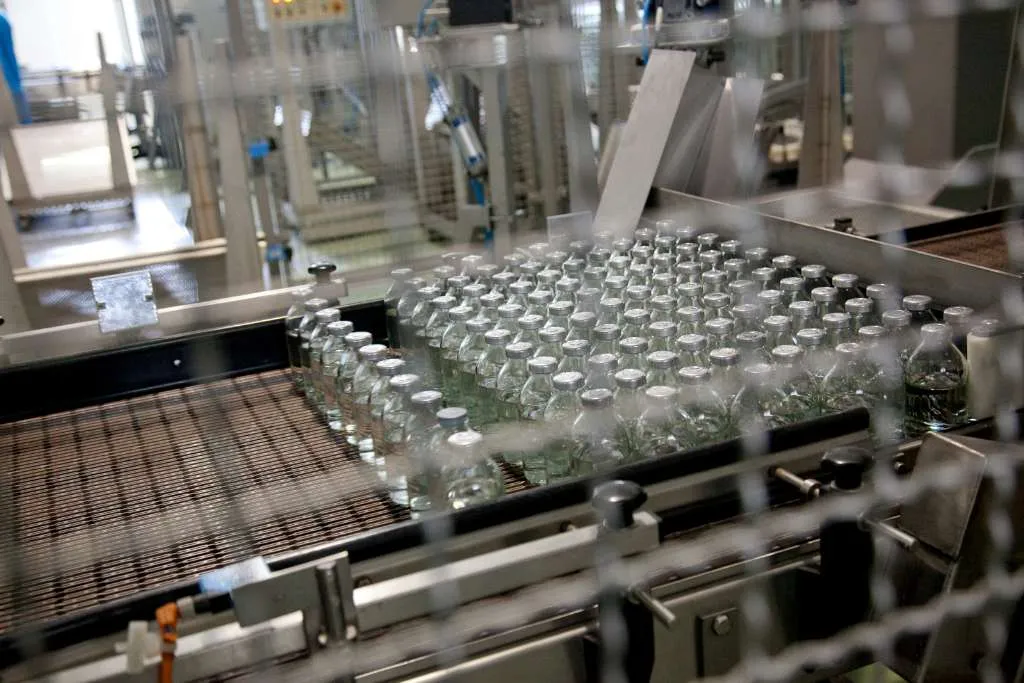
Sterile injectable facilities are designed for aseptic manufacturing, including fill-finish lines, sterile cleanrooms, HEPA filtration, isolators and RABS systems, and stringent contamination control.
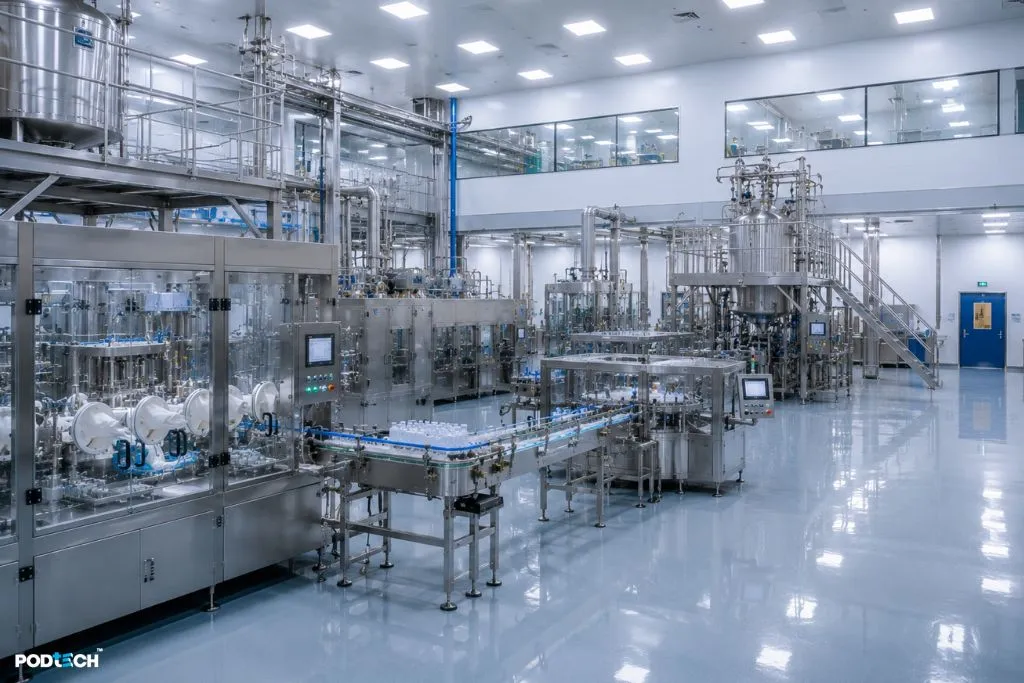
Biopharmaceutical manufacturing facilities are used for vaccines, biologics, cell therapies, and recombinant products. These facilities require advanced HVAC systems, bioreactors, process segregation, environmental monitoring, and flexible manufacturing layouts.
Meanwhile, active pharmaceutical ingredient (API) manufacturing plants facilities involve chemical processing, solvent handling, explosion protection, waste treatment systems, and hazardous material controls.
Finally, there are also R&D (research and development) facilities focused on small-scale development, pilot manufacturing, and process optimisation.
Each facility category requires unique engineering and operational strategies during pharmaceutical manufacturing facility design.
Core principles of pharmaceutical facility design
Successful pharmaceutical facility design balances compliance, efficiency, flexibility, and future scalability.
- GMP complianceGood manufacturing practice (GMP) regulations form the foundation of pharmaceutical plant design. Facilities must comply with WHO GMP, EU GMP, US FDA requirements, PIC/S standards and local regulatory frameworks. GMP regulations influence the design of material flow, personnel flow, cleanroom classification, surface finishes, air pressure differentials, environmental monitoring, and documentation systems.Modern modular facilities, like the ones we make at PodTech™, are increasingly designed with built-in GMP readiness to simplify qualification and validation processes. PodTech™’s modular systems, for example, are pre-engineered and pre-validated to support regulated pharmaceutical manufacturing environments.
- Contamination control
Contamination prevention is central to pharmaceutical manufacturing. Facility layouts must be designed to minimise cross-contamination, microbial contamination, product mix-ups, and human error. This is achieved through segregated manufacturing zones, controlled airflows, pressure cascades, airlocks, dedicated gowning areas, and unidirectional process flow. In sterile and biopharma environments, contamination control becomes even more critical because product integrity directly affects patient safety. - Process flow optimisation
Efficient pharmaceutical facility design ensures the smooth movement of raw materials, personnel, waste, equipment, and finished products. Good layouts eliminate bottlenecks and reduce unnecessary movement.Typical design considerations include separate entry and exit points, logical manufacturing sequences, segregated clean and dirty corridors, optimised warehouse access as well as simplified maintenance access. The goal is operational efficiency without compromising GMP compliance.
- Scalability and flexibility
Traditional pharmaceutical facilities often struggle with expansion because they are built for fixed production volumes. However, modern pharma markets require flexibility.
Manufacturers increasingly need to add new production lines, increase batch sizes, switch products, respond to public health emergencies, and scale rapidly. Modular pharmaceutical infrastructure addresses this challenge by enabling facilities to expand incrementally through prefabricated manufacturing units. PodTech™’s modular podule™ approach allows manufacturers to add scalable cleanroom and production capacity faster than conventional construction methods.
Key components of pharmaceutical manufacturing facility design
Site selection. Selecting the right location is one of the first and most important decisions when setting up a pharma production facility. Key considerations include utility availability, water quality, transportation access, skilled workforce availability, regulatory environment, climate conditions, supply chain connectivity, future expansion potential and so much more. Governments investing in pharmaceutical self-sufficiency often prioritise locations that support regional healthcare access and industrial growth.
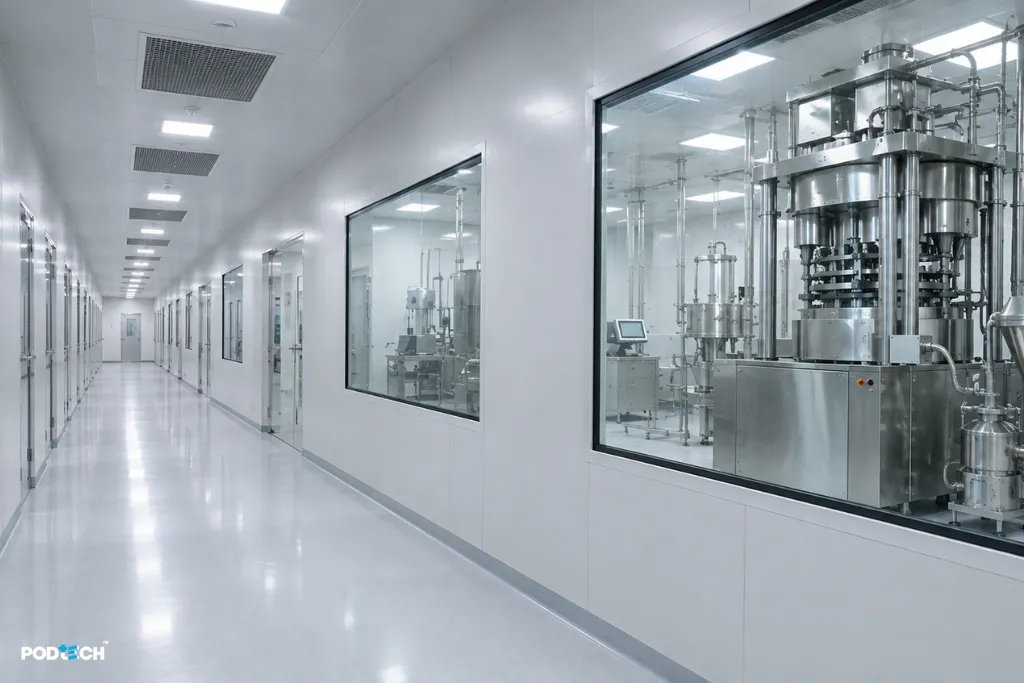
Cleanroom design. Cleanrooms are the heart of pharmaceutical manufacturing. A cleanroom controls not only temperature, humidity and pressure but also airborne particles and microbial contamination.
Pharmaceutical cleanrooms are classified according to ISO and GMP standards, with these standards defining permissible levels of contaminants as well as expected environmental conditions. Critical cleanroom design elements include HEPA or ULPA filtration, pressure differentials, air changes per hour (ACH), environmental monitoring, cleanable surfaces, and controlled access systems.
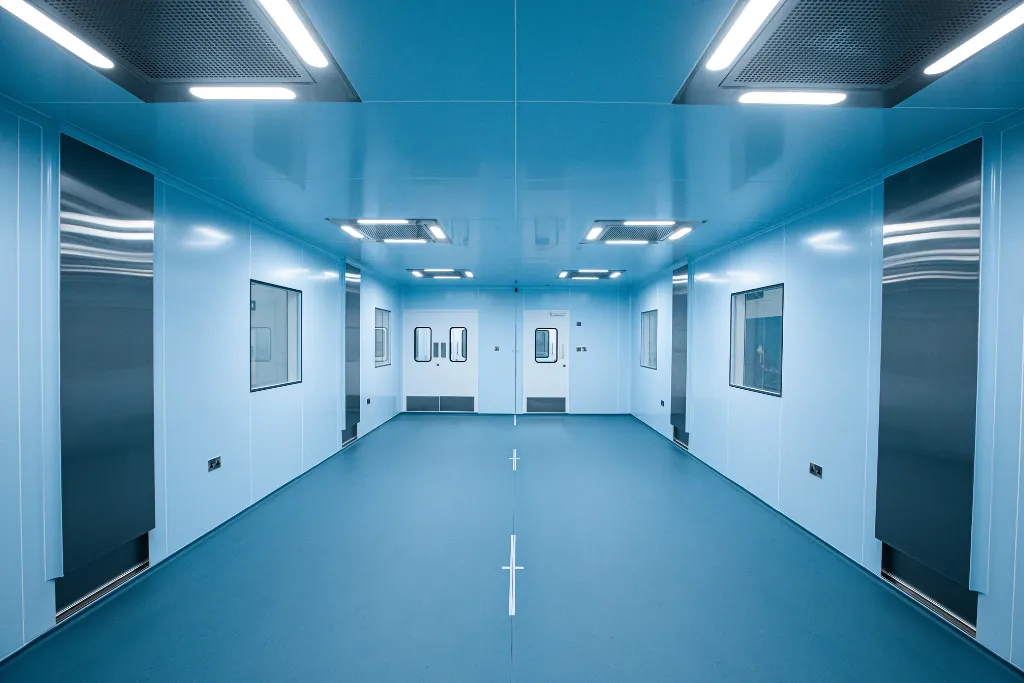
Modular cleanrooms are increasingly popular because they reduce construction time while maintaining strict compliance standards. For instance, PodTech™’s modular cleanroom systems integrate HVAC, utilities, fire protection, and environmental controls into self-contained units that can be rapidly deployed and scaled.
HVAC systems. HVAC is one of the most complex and expensive aspects of pharmaceutical manufacturing facility design. Critical HVAC considerations include redundancy, energy efficiency, pressure zoning, filtration strategy and maintenance accessibility.
A pharma plant’s HVAC system controls temperature, humidity, air cleanliness, air pressure and airflow direction. In GMP facilities, HVAC systems are also essential for contamination control. Biopharma facilities often require highly specialized HVAC systems to support aseptic manufacturing and biological processes.
Utility systems. Pharmaceutical facilities depend on robust utility infrastructure, with critical utilities including purified water systems, water for injection (WFI), clean steam, compressed air, nitrogen, electrical systems, backup power and waste management.
Regardless of the type of pharmaceutical facility design, utilities must be designed for reliability, redundancy, validation, monitoring and maintenance access. Modular utility integration significantly reduces project complexity and commissioning timelines.
Automation and digital infrastructure. Modern pharmaceutical plants increasingly rely on automation and digital manufacturing systems. These technologies improve process consistency, batch traceability, quality control, and operational efficiency. Typical digital systems include building management systems (BMS), manufacturing execution systems (MES), SCADA systems, environmental monitoring systems and electronic batch records. PodTech™ integrates building management and process utilities directly into its modular infrastructure platforms, helping accelerate facility readiness.
Stay tuned for part two of this blog post to understand the different types of pharma facility builds, the challenges involved in setting up a pharma production facility, and the future of pharmaceutical manufacturing facility design.
The pharmaceutical industry is increasingly shifting from traditional construction toward modular infrastructure.
Traditional pharmaceutical construction offers the advantages of fully customised layouts, large-scale permanent facilities, and familiar construction methodology. Nonetheless, there are also some challenges involved. Think long timelines, high construction risk, complex site coordination, difficult scalability, and operational disruption during expansion.
Meanwhile, modular infrastructure uses prefabricated production units manufactured off-site and assembled on-site. This gives you the advantages of faster project delivery, reduced on-site construction, lower project risk, easier scalability, improved quality control and reduced operational disruption. So efficient are modular pharmaceutical systems that they can reduce project schedules by up to 50% compared to conventional construction.
Challenges in building a pharma plant
Even with modern technology, pharmaceutical manufacturing facility design and construction projects remain highly complex. There are several challenges involved in building a pharma plant, many of which can be circumvented or mitigated by using modular and/or turnkey solutions.
Regulatory complexity. Manufacturers must satisfy multiple regulatory agencies, meeting their validation requirements, documentation standards, and audit readiness expectations
Long timelines. Traditional pharmaceutical construction often suffers from delayed approvals, construction bottlenecks, supply chain disruptions and utility integration challenges. Modular approaches help mitigate these risks by shifting much of the construction and validation work off-site.
Cost management. Pharmaceutical projects involve significant capital expenditure, with key cost drivers being sophisticated HVAC systems, cleanrooms, validation, specialised utilities, automation systems and compliance requirements. Lifecycle cost optimisation is therefore critical during the design phase.
Future-proofing. Facilities designed only for current production needs may become obsolete quickly. This is why, as a manufacturer, you must plan for future therapies, technology changes, capacity expansion, sustainability targets and flexible manufacturing. Scalable modular systems help you adapt to changing production requirements without major reconstruction.
Ultimately, modular matters. Modular facilities enable governments and manufacturers to respond faster to healthcare emergencies, build regional manufacturing capability, expand production capacity quickly and improve supply chain resilience. The Covid-19 pandemic highlighted the need for rapidly deployable pharmaceutical infrastructure. Even during the pandemic, modular pharmaceutical infrastructure played an important role in accelerating vaccine manufacturing capacity.
The importance of turnkey pharmaceutical project delivery
Pharmaceutical facility projects involve multiple disciplines. From architecture, mechanical engineering and process engineering to validation, automation, regulatory compliance and construction management. Coordinating these stakeholders can become extremely complex. That is why many manufacturers now prefer turnkey pharmaceutical project partners.
Turnkey pharma facility partners manage design, engineering, manufacturing, construction, validation, commissioning and handover. As a start-to-finish modular pharmaceutical infrastructure partner, we at PodTech™ integrate design, cleanrooms, utilities and deployment into a unified execution model. Our turkey approach and execution reduces project fragmentation, coordination risks, delays and compliance gaps. Importantly, it also provides a single point of accountability throughout the project lifecycle.
Sustainability in pharmaceutical facility design
Sustainability is becoming a major focus in pharmaceutical infrastructure development, as it is in many other industries. In keeping with ESG norms, modern facilities aim to reduce energy consumption, water usage, carbon emissions and construction waste.
Sustainable pharmaceutical design strategies include energy-efficient HVAC systems, smart building controls, renewable energy integration, water recycling, modular prefabrication and reduced construction waste.
Modular construction can support sustainability goals because off-site manufacturing improves material efficiency and reduces on-site disruption. Repurposability and adaptability also form an important part of any modular infrastructure strategy, especially for us at PodTech™.
The future of pharmaceutical manufacturing facility design
The pharmaceutical industry is evolving rapidly.
Increasingly, future facilities will prioritise flexibility, digitalisation, speed, regional resilience, sustainability, automation and modular scalability.
Governments worldwide are investing in local pharmaceutical manufacturing capability to reduce dependence on imports and strengthen healthcare security.
Modular pharmaceutical infrastructure is likely to play a major role in this transition because it enables not only faster deployment and lower capital risk but also incremental expansion and greater manufacturing resilience.
As pharmaceutical manufacturing becomes more decentralised and responsive, modular factory systems are emerging as a practical alternative to traditional construction.
Final thoughts
Designing and building a pharmaceutical manufacturing facility is one of the most complex infrastructure challenges in modern industry. Success depends on far more than constructing compliant walls and cleanrooms.
Manufacturers must create agile, scalable, future-ready environments capable of supporting evolving therapies, strict regulations and changing market demands.
Traditional construction methods still have a place, but the industry is increasingly recognising the advantages of modular pharmaceutical facility design:
- Faster deployment
- Greater flexibility
- Lower operational disruption
- Easier scalability
- Improved resilience
For governments, biotech companies, and pharmaceutical manufacturers looking to accelerate capacity building, modular infrastructure offers a compelling path forward.
Companies like us, PodTech™, are helping redefine pharmaceutical manufacturing through turnkey modular cleanrooms and prefabricated biopharma infrastructure designed for speed, compliance, and long-term adaptability. By combining engineering expertise, modular construction and end-to-end project execution, we are enabling organisations to build pharmaceutical manufacturing capability faster and more efficiently than traditional approaches.