The race to build biopharmaceutical capacity has fundamentally changed.
Not long ago, building a clinical biomanufacturing facility meant years of planning, fragmented vendor coordination, and constant uncertainty. Today, that model is increasingly out of step with the urgency of modern healthcare.
Clinical pipelines are expanding. Advanced therapies are becoming more complex. And timelines are shrinking. In this environment, companies are asking a different question:
Not “how do we build faster?” but “how do we build smarter, with less risk?”
That shift is exactly why turnkey solutions are rapidly becoming the industry standard.
The new reality of clinical manufacturing
As a clinical biomanufacturer, you may be involved in the production of antibodies, vaccines, cell and gene therapies, or any other biological materials. Whether you’re involved in clinical API manufacturing, clinical trial manufacturing, or developing a clinical manufacturing facility in pharma, the risks and pressures are similar.
For starters, speed to clinic is critical. This is essential from not only a patient health perspective but also from a competitive perspective: you want to be the first, the fastest to get to market with a safe and quality product.
As with any product intended for human consumption, regulatory compliance is non-negotiable. This is essential to protect the health of consumers, your workforce, the broader community, as well as the environment.
Today, capital efficiency also matters more than ever. Resources are precious, economic pressures are strong, and making intelligent investments is not negotiable.
Finally, if you want to meet the standards and pressures that come with new products and technologies, flexibility is no longer optional.
Traditional construction models struggle to keep up with these demands. They rely on multiple vendors, sequential timelines, and site-heavy execution. Each phase introduces delays, coordination gaps, and compliance risks. When you’re setting up a clinical biomanufacturing facility, those risks compound quickly. And they have knock-on effects on your budget, timelines, and eventually, your success in the market.
Why the traditional model for building clinical biomanufacturing facilities falls short
Let’s be honest. The conventional approach to facility building is not designed for today’s pace.
A typical project might involve separate design consultants, cleanroom panel suppliers, HVAC contractors, utility vendors, automation providers, and validation specialists among other experts.
Each is a specialist, but each also operates in a silo.
The result? Unfortunately, bringing together separate consultants and experts for each aspect of facility construction often results in misaligned timelines, integration issues, cost overruns, and/or delayed regulatory readiness.
Even under ideal conditions, projects can take years. And that’s before factoring in real-world disruptions. Think geopolitical tensions, climatic events, economic crises, or any other global event beyond your control.
At PodTech™, we are reimagining the process of building a clinical biomanufacturing facility because we’ve seen that traditional setups often face long timelines and inefficiencies that delay critical healthcare delivery. Turnkey solutions are the only way forward, with modular and prefabricated components effectively enabling the delivery of these solutions.
The shift toward turnkey solutions for setting up a clinical biomanufacturing facility
Turnkey is not just a delivery model. It’s a mindset shift.
If you’re setting up a clinical biomanufacturing facility, instead of managing multiple vendors, you can partner with a single provider responsible for all aspects of getting your facility up and running. Design, engineering, manufacturing, integration, commissioning, and validation. At the end of the process, your turnkey solutions provider should hand over a fully operational facility.
With traditional builds, the expectation is simply delivering infrastructure. With our turnkey solutions, we at PodTech™ are redefining that expectation. When we say “turnkey”, we mean that we deliver complete, pre-engineered, pre-validated, and ready-to-operate facilities that dramatically reduce complexity and risk.
What “turnkey” really means in biomanufacturing
The term “turnkey” is often used loosely. In reality, true turnkey delivery includes several critical elements.
- Integrated design and engineering
When building a turnkey clinical manufacturing facility in pharma, instead of designing in isolation, every component is engineered as part of a unified system. This ensures that the process flow is seamless, layouts are optimised, compliance is built into the system, and delays and budget overruns from reworking elements is minimised.
- Offsite manufacturing
As a turnkey facility partner, PodTech™’s model emphasises pre-fabricated, modular construction, where facility components are built offsite in controlled environments.
This approach reduces the risks and delays that are inevitable with on-site work in traditionally factory construction. This not only accelerates timelines, but also improves facility quality because factory panels and components are manufactured in a controlled environment with more reliable quality assurance mechanisms than on-site processes.
These systems are built entirely offsite, delivered fully assembled, and prevalidated, significantly reducing project disruption and delays.
- Pre-validation and testing
One of the biggest advantages of turnkey systems is that validation begins before the facility even arrives on site. Factory acceptance testing (FAT), site acceptance testing (SAT), and qualification documentation are all integrated into the delivery process.
- Plug-and-play deployment
Instead of months of installation and commissioning, facilities can be rapidly deployed and made operational in a fraction of that time. This is a benefit of modular construction. When combined with the other services provided by a turnkey facility partner, it gives you a facility that is ready to operate from day one: plug-and-play, as we like to call it.
Modular construction matters, but it’s a means, not the end
Often, potential customers come to us with some confusion between “modular” and “turnkey.” Here’s what we tell them.
Modular construction is a method. Turnkey delivery is the outcome.
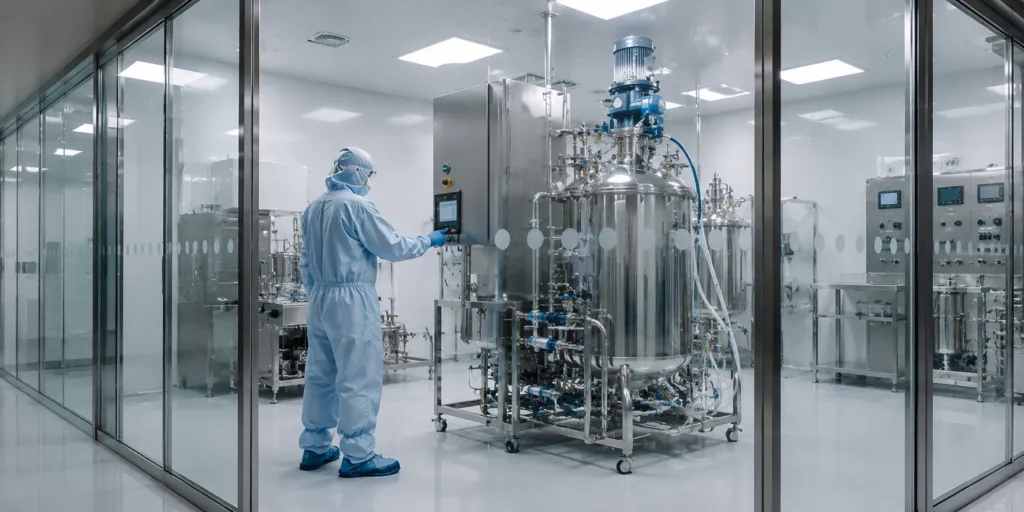
At PodTech™, we use modular, prefab architecture to achieve speed and efficiency. Our podule™ systems are self-contained units with built-in air handling, utilities, and control systems. We provide options for tech transfer and take care of commissioning and validation.
Our podules™ are modular systems, built off-site and only assembled on-site. But their real value lies beyond modularity. It lies in us delivering a complete, operational manufacturing environment, with our team of experts handling everything from project management and system integration to regulatory compliance.
In part two of this blog post, we’re going to explore exactly why it is that turnkey factory solutions are becoming the industry standard in not only clinical manufacturing, but also semiconductor, aerospace, defense, and other rapidly evolving industries.
Turnkey is the solution to the manufacturing problems faced by many industries. Stay tuned to find out why.
Modular construction matters when it comes to setting up a clinical biomanufacturing facility. But it’s not the real win. Modular construction, especially at PodTech™, is in service of providing turnkey solutions that make the process of building a clinical biomanufacturing facility that much more streamlined.
Speed without compromise
Relying on turnkey solutions for clinical API manufacturing, clinical trial manufacturing, or any other high-precision, high-cleanliness process offers many benefits. But arguably one of the strongest arguments for turnkey solutions is speed.
Traditional facilities can take several years to complete. In contrast, our turnkey systems can be deployed in as little as 12 to 18 months, enabling you to respond faster to evolving market and clinical demands.
This is particularly critical in clinical trial manufacturing, pandemic response, and the rapid scale-up of new therapies. In these domains, speed is not just a competitive advantage. It can and does directly impact patient access to life-saving treatments.
So, at the end of the day, going the turnkey route can be the deciding factor between life and death, between health and illness, for many patients.
Reducing risk across the project lifecycle
When setting up a clinical biomanufacturing facility, risk exists at every stage. There could be design errors, construction delays, integration failures, and/or compliance gaps. When you’re working with multiple vendors, the likelihood of some things slipping through the cracks is naturally higher. And identifying who is accountable for some of these errors can be even harder.
Turnkey models mitigate these risks by centralising accountability. Your turnkey facility partner is responsible for standardising processes, pre-validating systems, and ensuring end-to-end visibility. Instead of managing risk across multiple vendors, you work with a single partner responsible for the final outcome.
Built for regulatory confidence
Regulatory readiness is one of the most challenging aspects of clinical manufacturing. Facilities must meet stringent standards for cleanroom classification, environmental control, process integrity, and documentation.
Turnkey solutions embed compliance into the design from day one. For instance, PodTech™’s systems include not only well-designed and -engineered controlled environments, but also integrated building management systems (BMS), validated utilities, and comprehensive documentation. This ensures facilities are not just built quickly, but built right.
Flexibility for a changing pipeline
Clinical manufacturing is inherently unpredictable. Processes evolve. Pipelines shift. Capacity needs change.
Traditional facilities are rigid. Brick-and-mortar structures constructed on-site by an assortment of suppliers and contractors just cannot offer the level of agility that you need in for a clinical manufacturing facility in pharma or any other rapidly evolving industry, for that matter.
Turnkey modular systems, on the other hand, are designed for adaptability. Our solutions at PodTech™ are testament to the fact.
At PodTech™, our approach allows facilities to scale up or down, reconfigure layouts, or repurpose for new therapies relatively quickly. This flexibility is especially valuable in areas like cell and gene therapy, oncology manufacturing, and personalised medicine where demand is fairly niche and evolves quickly with the disease burden.
Supporting global health and local manufacturing
Another major driver behind the shift to turnkey is the need for localised manufacturing.
Many regions still lack adequate pharmaceutical infrastructure, leading to dependence on imports and delayed access to medicines. Turnkey solutions are the best solution to this problem of no, low, or delayed access.
Turnkey clinical manufacturing facilities enable rapid deployment in emerging markets, reduced reliance on global supply chains, and consequently, greater healthcare resilience.
This is not just a business advantage. It is a strategic, economic, and global health imperative.
Cost efficiency without cutting corners
At first glance, turnkey solutions may seem like a premium option. In reality, they often deliver better cost efficiency over the project lifecycle.
Why? This is due to reduced construction time, lower coordination costs, fewer delays and reworks, and optimised resource utilisation.
PodTech™’s prefab systems, for example, are designed to minimise construction waste, minimise construction labour requirements, and maximise time and energy efficiency, leading to both capital and operational savings. In the long run, turnkey solutions generally work out to be the better financial decision.
The turnkey route: a better way to build clinical manufacturing capacity
In the biopharma, semiconductor, electronics, aerospace and many other high-precision industries, the question is no longer whether turnkey solutions are viable. It’s whether traditional models can keep up.
Specifically, for organisations building a clinical biomanufacturing facility, expanding clinical API manufacturing capabilities, or scaling clinical trial manufacturing, the advantages of turnkey are becoming impossible to ignore.
Why companies are choosing PodTech™
PodTech™ represents a new category of partner. Not just a supplier. Not just a contractor. But a turnkey facility provider.
As a turnkey facility provider, PodTech™ delivers pre-engineered systems built using modular prefab infrastructure with integrated utilities and controls, prevalidated environments, and end-to-end project execution. Our plug-and-play factory systems are designed to simplify complexity and accelerate outcomes.
Our goal is simple: to make biopharma manufacturing capacity building faster, more accessible, and more reliable.
Building a clinical biomanufacturing facility? The future is turnkey
The pharmaceutical industry is evolving. And the way facilities are built must evolve with it.
Turnkey modular solutions offer speed, certainty, compliance, flexibility, and scalability. They reduce risk, simplify execution, and enable faster access to critical therapies. Most importantly, they align with the realities of modern biomanufacturing.
Building a clinical facility will never be simple. But it doesn’t have to be fragmented, slow, or unpredictable.
Turnkey solutions are redefining what’s possible. And companies like PodTech™ are leading that shift by delivering not just infrastructure, but fully operational, ready-to-run manufacturing environments.
For organisations looking to move faster, reduce risk, and stay competitive, our message is clear: turnkey is no longer an alternative. It’s becoming the standard.