Setting up a tablet manufacturing plant is about much more than installing a tablet press and finding enough floor space around it.
A modern tablet manufacturing facility has to bring together raw-material handling, formulation, processing, compression, coating, packaging, quality control, utilities, HVAC, personnel movement and waste management within a controlled environment. Every one of these elements has implications for product quality, regulatory compliance and ultimately, the economics of the plant.
The challenge becomes even greater when the facility is expected to manufacture multiple products. Different APIs and formulations can introduce different contamination, dust-handling and cleaning requirements. At the same time, manufacturers increasingly need facilities that can accommodate changes in product mix and production volumes without requiring a complete redesign.
That is why any tablet manufacturing plant setup should begin with process and business requirements, not construction.
Before deciding how large the building should be or which construction technology to use, manufacturers need to answer a more fundamental question:
What exactly does this facility need to produce, and at what scale?
This article looks at the key considerations involved in planning a tablet manufacturing plant, from the tablet manufacturing process and equipment requirements to GMP compliance and the early stages of facility planning.
Start with the manufacturing strategy.
The first step in planning a tablet manufacturing facility is defining its intended role.
Is it intended for:
- Development and pilot-scale production?
- Clinical batches?
- Commercial-scale manufacturing?
- Contract manufacturing?
- A single high-volume product?
- Multiple products and dosage strengths?
- Domestic production or export markets?
These questions determine almost every subsequent design decision.
For example, a facility manufacturing a small number of high-volume products may prioritise highly efficient production lines and large equipment. A contract manufacturing facility, by contrast, may need greater flexibility, faster changeovers and more robust segregation and cleaning strategies.
Production volume also affects the required capacity of individual process areas. A high-capacity compression suite will have very different requirements from a facility designed around smaller batches.
The mistake is to begin with a predetermined building size and then attempt to fit the process into it. A better approach is to work backwards from the manufacturing strategy.
Product → process → equipment → flows → rooms → facility
Understand the tablet manufacturing process.
The exact process varies according to formulation, API characteristics and product requirements, but a conventional tablet manufacturing process can include several key stages.
Raw-material receipt and storage.
APIs, excipients and packaging materials enter the facility through controlled receiving and storage areas. Materials need to be appropriately identified, quarantined where required, sampled and released before entering production. Storage conditions may also need to account for temperature, humidity, light sensitivity or other product-specific requirements.
The facility therefore needs more than a warehouse. It needs a controlled material-management system.
Dispensing.
Released raw materials are weighed and dispensed according to the batch manufacturing record. Dispensing is particularly important from a facility-design perspective because powders can generate dust. The area must therefore be designed to control airborne particulate and prevent contamination or mix-ups.
Material movement should also be carefully planned. Raw materials should not have to travel unnecessarily through manufacturing areas to reach the next stage of production.
Granulation.
Depending on the formulation, powders may undergo wet granulation or dry granulation before compression.
Wet granulation generally involves mixing the formulation with a granulating liquid, followed by granulation and drying. Dry granulation may use equipment such as roller compactors to densify the powder without adding liquid. Some formulations may instead use direct compression, eliminating the granulation stage altogether.
This distinction has major implications for facility planning. A direct-compression process requires a different equipment train and utility profile from a wet-granulation process involving high-shear granulators, fluid-bed dryers and associated systems.
Milling and blending.
After granulation and drying, material may be milled to achieve the required particle characteristics. The material is then blended with other components to achieve a uniform distribution of the active ingredient and excipients.
Blending equipment and material-transfer systems need to be selected according to batch size, formulation and containment requirements.
Compression.
The blended formulation is fed into a tablet press, where it is compressed into tablets of the required size, shape and weight.
Compression is often one of the most visually recognisable stages of tablet manufacturing, but it is also one of the areas where facility design becomes particularly important.
Tablet compression can generate significant quantities of powder and particulate matter. The room therefore needs appropriate dust-control measures, ventilation and pressure relationships. Equipment placement must also allow sufficient space for operation, cleaning, maintenance and material movement.
Coating.
Some tablets are coated to protect the formulation, control drug release, improve stability or improve appearance and swallowability.
Coating typically involves applying a coating solution or suspension while tablets are continuously mixed and dried. Depending on the formulation and coating system, this introduces additional requirements for air handling, temperature and humidity control, exhaust and solvent or process-fluid management.
Inspection and packaging.
Finished tablets may undergo inspection before moving into primary and secondary packaging. Packaging operations must be designed to prevent product mix-ups and ensure correct labelling and traceability. Packaging areas therefore form an important part of the overall manufacturing flow rather than being treated as an afterthought.
Design around the process, not the equipment catalogue.
One of the most important principles in tablet manufacturing plant setup is that equipment selection and facility design should happen together.
It is tempting to purchase equipment first and then ask an architect or contractor to create rooms around it. That approach can create problems.
A tablet press, for example, is not simply a piece of machinery occupying a certain footprint. It requires:
- Operator access
- Material loading and unloading
- Cleaning access
- Maintenance clearance
- Dust extraction
- Electrical connections
- Appropriate HVAC
- Product and personnel movement around the equipment
The same applies to granulators, blenders, fluid-bed dryers, coating machines and packaging lines. The facility needs to accommodate the entire operating envelope of the equipment, not merely its physical dimensions.
GMP needs to be considered from day one.
GMP is not a certification that can simply be obtained after construction is complete. It needs to influence the design of the facility from the beginning.
WHO describes GMP as a system intended to ensure that pharmaceutical products are consistently produced and controlled according to appropriate quality standards. GMP addresses everything from starting materials and premises to equipment, personnel, procedures and documentation.
For a tablet manufacturing facility, one of the central objectives is controlling the risk of:
- Cross-contamination
- Mix-ups
- Incorrect labelling
- Contamination from personnel or the environment
- Product residues
- Inadequate cleaning
- Uncontrolled material or personnel movement
This is why facility design and GMP compliance cannot be separated. The layout itself becomes a quality-control tool.
In part two of this blog post, we’re going to explore more regarding the tablet manufacturing plant setup process. From regulatory requirements to cleaning to construction technology, we’ll address it all.
In part one of this blog post, we addressed pharmaceutical tablet manufacturing strategy and process. Now, it’s time to go further. Continuing from where we left off, let’s look at the next steps involved in planning a tablet manufacturing plant.
Regulatory requirements depend on the target market.
A tablet manufacturing plant needs to be designed against the regulatory requirements applicable to the markets it intends to serve.
For example, manufacturers in India need to consider the requirements of the Drugs and Cosmetics framework and applicable GMP provisions under Schedule M. CDSCO’s published material includes requirements concerning pharmaceutical premises, plant and equipment, including measures intended to minimise contamination and mix-ups.
Manufacturers targeting other markets may also need to design around requirements such as WHO GMP, EU GMP or US FDA expectations. The important point is that the facility should not be designed around the minimum requirements of one market if the business strategy is likely to include international markets later. A plant designed with future regulatory requirements in mind can provide considerably more flexibility than one that has to be extensively modified during expansion.
WHO’s current GMP resources also emphasise risk management, validation, quality systems and appropriate premises and equipment as integral parts of pharmaceutical manufacturing.
Plan for contamination and cross-contamination control.
For a tablet manufacturing plant, contamination control is one of the most important design considerations. Powder handling presents particular challenges because airborne particles can travel beyond the immediate processing area.
The facility therefore needs to consider:
- Room pressure relationships
- Airflow direction
- Dust extraction
- HVAC zoning
- Personnel movement
- Material movement
- Equipment cleaning
- Waste movement
- Segregation of products where necessary
The level of segregation required depends on the products being manufactured and the risks they present. PIC/S GMP guidance states that premises and equipment should be designed to minimise risks of errors and permit effective cleaning and maintenance, while cross-contamination controls should be proportionate to the risks involved.
This is particularly relevant to multiproduct facilities. A manufacturer producing several formulations cannot simply assume that the same room configuration will work equally well for every product.
Cleaning needs to influence the layout.
Cleaning is sometimes treated as an operational activity that happens after the facility has been designed. It should be the opposite. The layout, finishes, equipment positioning and accessibility should make effective cleaning possible.
WHO guidance highlights cleaning as an important control against contamination and cross-contamination, particularly in multiproduct facilities. It also notes the role of cleaning validation in demonstrating that equipment can be consistently cleaned to an acceptable level.
This means designers need to think about questions such as:
- Can operators actually access the equipment surfaces that need cleaning?
- Can product residues accumulate in difficult-to-reach locations?
- Can equipment be dismantled and cleaned without disrupting adjacent operations?
- Where does dirty equipment go?
- How are cleaned components stored before reuse?
These questions can have a significant impact on room dimensions and equipment placement.
Don’t forget utilities.
The manufacturing process is only one part of the facility. A tablet manufacturing plant also depends on supporting systems such as:
- HVAC
- Electrical power
- Compressed air
- Process water
- Dust extraction
- Exhaust systems
- Fire protection
- Drainage
- Temperature and humidity control
- Monitoring and automation systems
Utility requirements should be calculated from the actual equipment and process requirements. HVAC deserves particular attention because it contributes directly to environmental control and contamination management. WHO has specific GMP guidance addressing HVAC systems for non-sterile pharmaceutical products.
The HVAC strategy should therefore be developed alongside the room zoning and process flows, rather than being added after the architectural layout has been finalised.
Build flexibility into the master plan.
A tablet manufacturing plant may look completely adequate on the day it starts production and become a constraint five years later.
Demand may increase. New products may be introduced. A company may move from domestic to export markets. A contract manufacturer may acquire new clients with different batch sizes.
The facility should therefore be planned with future change in mind. This could mean:
- Reserving space for additional equipment
- Designing utility systems with expansion capacity
- Providing suitable access routes for future equipment installation
- Creating adaptable production areas
- Planning future warehouse expansion
- Designing structural and service provisions for additional modules or rooms
This is one area where modular construction can become particularly interesting. Rather than treating the facility as a fixed building, manufacturers can consider whether some areas could be designed as modular components that can be installed, expanded or reconfigured as requirements change.
That does not mean every part of a tablet manufacturing plant should automatically be modular. The construction model should follow the requirements of the project.
Layout, HVAC, equipment and modular construction.
A successful tablet manufacturing plant begins long before construction.
The tablet manufacturing process, product portfolio, production volumes, regulatory strategy and future expansion plans all need to be understood before the facility layout is finalised. GMP considerations should be embedded into the design from the beginning, with particular attention to contamination control, material and personnel flows, cleaning, HVAC and equipment accessibility. And perhaps most importantly, the facility should be designed for the manufacturing strategy, not the other way around.
Once those fundamentals are established, the next question is:
What should the physical tablet manufacturing facility actually look like?
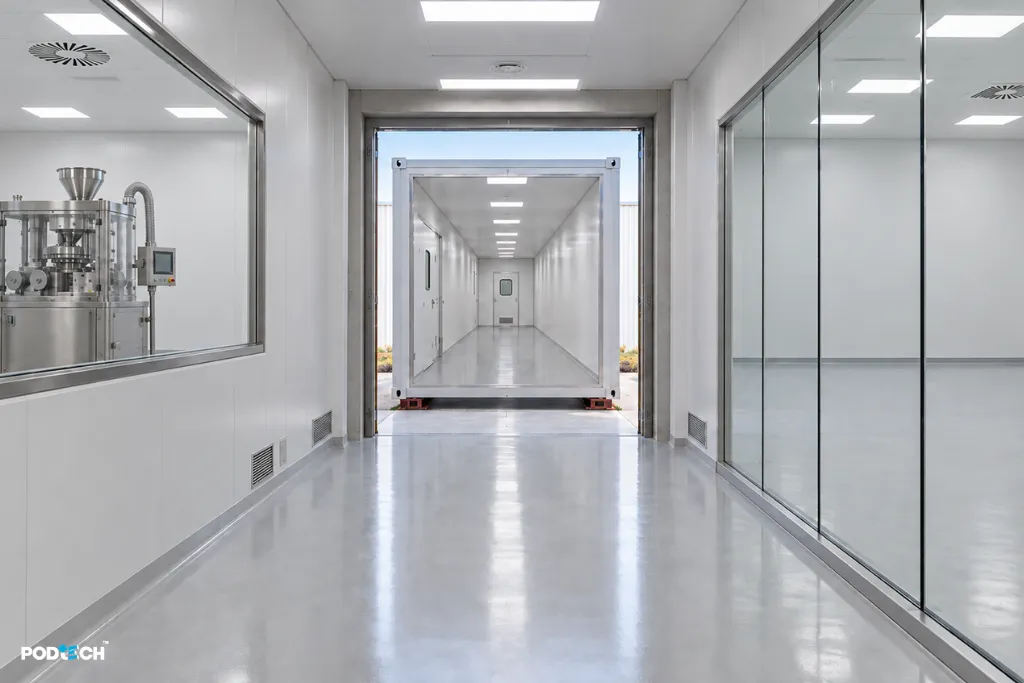
Once the tablet manufacturing process has been mapped out and the regulatory requirements are understood, the next challenge is translating that process into a physical facility. This is where facility design becomes more than architecture.
A well-designed tablet manufacturing facility should allow materials to move logically from receipt to production to packaging and dispatch. Personnel should be able to enter and exit controlled areas without creating unnecessary contamination risks. Equipment should have sufficient space for operation and maintenance. HVAC should support the required environmental conditions. And the facility should provide enough flexibility to accommodate future changes.
In other words, the layout itself should support the manufacturing process. For pharmaceutical manufacturers planning a new facility, this is also where the choice between conventional construction, modular construction or a combination of both becomes relevant.
The term “modular” can mean different things, but the basic idea is to move some elements of construction and assembly away from the project site and into a controlled manufacturing environment.
For pharmaceutical facilities, this can potentially offer several advantages:
- Greater off-site fabrication
- Reduced dependence on site labour
- More predictable manufacturing conditions
- Faster installation of certain facility components
- Repeatability
- Easier phased expansion
- Reduced disruption during certain expansion projects
The advantages are particularly relevant when projects are being executed in regions where skilled construction labour or specialised cleanroom expertise is difficult to access.
Why a hybrid approach can make more sense.
A pharmaceutical facility is a complex combination of permanent infrastructure and specialised manufacturing environments.
Some parts may benefit from conventional construction. These could include:
- Structural buildings
- Warehouses
- Utility buildings
- Heavy equipment foundations
- Site infrastructure
- Large service areas
Other components, like cleanrooms, may be well suited to prefabrication or modular construction, particularly where repeatability, controlled fabrication or rapid deployment provides an advantage.
This creates a third option between “traditional” and “fully modular”: a hybrid or fusion facility. Instead of forcing the entire project into one construction methodology, the facility is divided according to its functional requirements.
A final word.
A tablet manufacturing facility is ultimately a system. The building, equipment, HVAC, utilities, people, materials and processes all need to work together.
That is why the most important decision during a tablet manufacturing plant setup is not necessarily whether to choose a conventional or modular building. It is whether the entire facility has been designed around the manufacturing process and the risks associated with it.
For some projects, conventional construction may remain the most appropriate solution. For others, a modular approach can offer valuable advantages in speed, flexibility and controlled execution. And for increasingly complex projects, the best answer may be somewhere between the two.
A modular tablet manufacturing facility does not have to mean replacing the entire building with prefabricated modules. It can mean identifying the parts of the facility where modular construction creates genuine value, and combining those components with conventional infrastructure where that approach makes more sense.
That is ultimately the goal of good facility planning: not choosing a construction technology first, but choosing the solution that best fits the manufacturing problem.
The right tablet manufacturing plant is not simply the one that can produce tablets. It is the one designed to produce them safely, consistently, and compliantly. And adapt as the business grows.