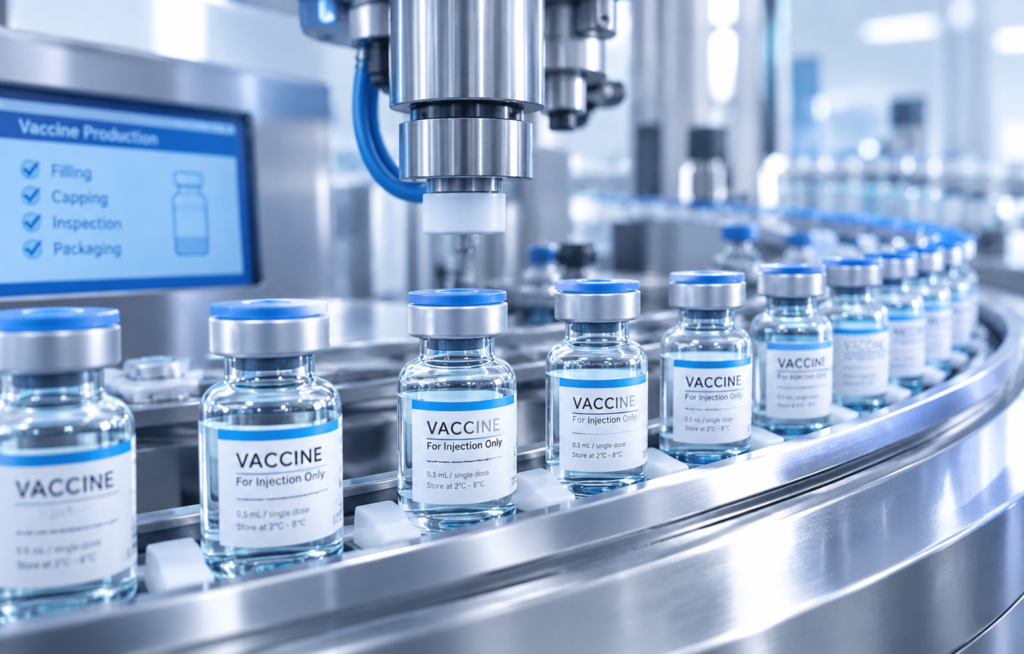
Vaccine manufacturing is one of the most demanding areas of pharmaceutical production. A vaccine manufacturing plant must support complex biological processes while maintaining stringent standards for contamination control, environmental conditions, quality assurance and process consistency.
At the same time, vaccine demand can change quickly. Manufacturers may need to increase capacity, introduce new vaccine technologies, respond to public health requirements or establish production closer to the markets they serve.
This creates an important question:
How can manufacturers build vaccine manufacturing capacity quickly without compromising flexibility, quality or long-term performance?
A modular vaccine manufacturing facility can be part of the answer.
Modular construction allows significant portions of a facility to be fabricated, assembled and tested away from the final site before being installed. WHO’s vaccine GMP training materials specifically identify modularisation as an approach that can move much of the construction work into a dedicated fabrication environment, potentially reducing the time required for construction, qualification and validation.
But setting up a modular vaccine facility isn’t simply a matter of putting production equipment inside prefabricated rooms. The modular approach has to begin with the manufacturing process itself.
Start with the vaccine manufacturing process.
Every vaccine manufacturing facility is shaped by the product it is intended to make.
The process may involve stages such as antigen production, harvesting, purification, formulation, filling and packaging, depending on the vaccine platform. Different technologies also have different requirements for biosafety, containment, environmental control, utilities and equipment.
This means the first step in vaccine manufacturing facility design should be defining the process requirements.
Questions to answer include:
- What vaccine(s) will be manufactured?
- What is the expected batch size?
- What production capacity is required?
- Will the facility manufacture one product or multiple products?
- Which process steps will take place on site?
- What level of containment is required?
- Will production use single-use or stainless-steel systems?
- What are the requirements for formulation and filling?
- What quality control and analytical laboratories are required?
- How much future expansion should the facility accommodate?
These decisions influence everything from room layouts and material flows to HVAC systems, utilities and equipment selection.
WHO’s vaccine prequalification guidance, for example, expects manufacturers to document manufacturing and quality-control areas, air and material flows, room classifications, ventilation systems, water systems, equipment, cleaning procedures, and qualification and validation procedures.
In other words, facility design has to follow the manufacturing process, not the other way around.
What does vaccine manufacturing facility design need to consider?
A vaccine manufacturing facility needs carefully planned segregation and controlled movement of people, materials, products and waste.
This is particularly important where there are contamination or cross-contamination risks. The facility layout should support logical movement through the manufacturing process while preventing unnecessary interaction between different flows.
Depending on the vaccine and process, the design may need to accommodate:
Controlled manufacturing areas.
Manufacturing rooms need finishes, environmental conditions and layouts appropriate for their intended use. Cleanroom classifications and environmental controls will depend on the specific manufacturing operations being performed.
HVAC and air handling.
Air handling is a major component of vaccine manufacturing facility design. Pressure relationships, air changes, filtration, temperature, humidity and room classifications need to be considered alongside the process and contamination-control strategy.
Water systems.
Pharmaceutical water systems need to be designed around the requirements of the manufacturing process. WHO guidance notes that vaccine manufacturing documentation should describe water systems, including storage, distribution loops, points of use, sampling points and sanitation procedures.
Utilities.
A facility may require systems for purified water or WFI (water for injection), clean steam, compressed gases, electrical power, HVAC and other process-specific utilities.
Quality control.
Laboratories and sampling areas need to be integrated into the facility rather than treated as an afterthought. Testing requirements can influence both the layout and the movement of samples through the facility.
Personnel and material flows.
Personnel entry, gowning, material transfer and waste movement should all be considered during the design stage.
At the end of the day, the goal is not simply to create rooms that meet a specification. It is to create a facility in which the entire manufacturing workflow supports GMP requirements.
Where does modular construction fit?
This is where modular construction becomes interesting.
Not every part of a vaccine manufacturing plant needs to be constructed in exactly the same way.
A traditional stick-built approach may make sense for permanent structural elements and infrastructure. Modular construction, meanwhile, can be particularly useful for areas where speed, repeatability and future flexibility are important.
For example, modular solutions may be considered for:
- Cleanroom environments
- Process rooms
- Laboratories
- Gowning areas
- Technical spaces
- Utility modules
- Support areas
- Expansion modules
The precise application depends on the project.
This is important because a modular vaccine manufacturing facility does not have to mean a 100% modular facility.
In fact, a hybrid approach can sometimes make more sense. Different parts of a high-tech facility can have different requirements, and combining conventional construction with modular and prefabricated solutions can provide a better balance of durability, flexibility and speed.
Why modularisation can make sense for vaccine manufacturing.
One of the biggest advantages of modularisation is that some work can happen away from the construction site.
Instead of fabricating every component on site, modules can be manufactured in a controlled environment and transported to the project location. This can potentially reduce the amount of site-based work and dependence on local skilled labour. It can also allow multiple activities to happen in parallel rather than forcing every stage of construction to follow a single sequential timeline.
For vaccine manufacturing projects, where cleanroom construction/installation and controlled environments are particularly important, shifting more work into a controlled fabrication environment can have practical advantages.
There is another benefit: repeatability.
If a manufacturer expects to expand capacity over time, designing standardised modules from the beginning can make subsequent expansion more straightforward. That could be particularly valuable for manufacturers dealing with uncertain demand or developing multiple products.
Designing for expansion.
Vaccine manufacturing capacity shouldn’t necessarily be designed only around today’s requirements.
Demand can change. Production may move from clinical to commercial scale. New vaccine technologies may be introduced. A manufacturer may need additional filling capacity, new formulation areas or additional quality-control capabilities.
A modular approach can allow some of these future requirements to be considered from the beginning.
Instead of asking, “How large does this facility need to be today?”, the better question may be, “How does this facility need to evolve over the next five, ten or fifteen years?”
That changes the approach to facility design. Expansion zones, utility capacity, structural interfaces and connection points can all be considered early, reducing the need for disruptive modifications later.
Modular does not mean compromising on GMP.
A common misconception is that modular construction is primarily about speed.
Speed matters, but it cannot come at the expense of GMP.
WHO states that GMP applies to the premises, systems, utilities, equipment, personnel and processes involved in pharmaceutical and biological production, including vaccines. These elements need to be appropriately designed, controlled, validated and documented.
That means modular components still need to be designed around the same fundamental quality requirements as conventionally constructed facilities.
Qualification and validation also need to be considered from the beginning. WHO’s validation guidance covers activities including design qualification, factory acceptance testing, installation qualification, operational qualification and performance qualification.
This is why modular vaccine facility design should involve engineering, manufacturing, quality and validation teams early in the project.
The objective isn’t simply to build faster. It is to create a facility that can be qualified, validated, operated and expanded reliably.
A final word.
Setting up a modular vaccine manufacturing facility begins long before the first module is fabricated.
The project needs to start with the vaccine manufacturing process, define the quality and regulatory requirements, map personnel and material flows, establish utility and environmental requirements, and determine which parts of the facility benefit from modularisation.
The result may be fully modular, conventionally built, or a combination of both. The important thing is to choose the construction model according to the requirements of the facility.
In part 2, we’ll look at the economics of modular vaccine facilities, including what drives modular vaccine manufacturing facility cost, how to approach qualification and validation, and why a hybrid construction model may be the right choice for some vaccine manufacturing projects.